Hackathon / National IT Carnival
PSTU IT Carnival 2026 – Hackathon
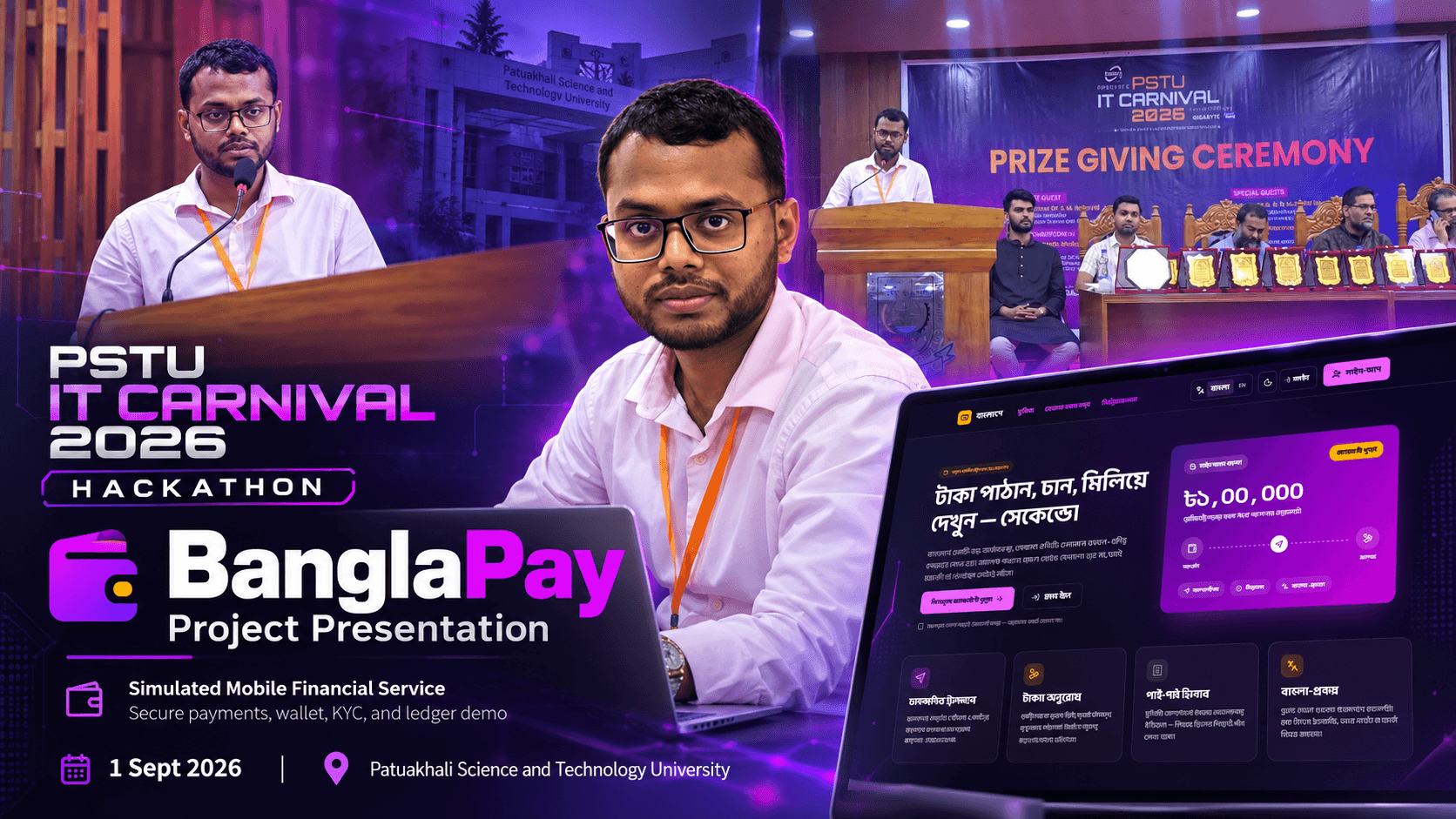
Participated in the PSTU National Hackathon 2026 with BanglaPay, a simulated mobile financial service designed to demonstrate secure and trustworthy digital money movement. The project included mobile registration, virtual OTP, secure PIN authentication, OCR-assisted NID KYC, device control, simulated BDT wallets, transfers, payment requests, receipts, and an append-only double-entry ledger.
DateTuesday, September 1, 2026
LocationPatuakhali Science and Technology University (PSTU), Patuakhali, Bangladesh
FormatHackathon / National IT Carnival
Step 01: Overview
On 1 September 2026, I participated in the PSTU IT Carnival 2026 Hackathon at Patuakhali Science and Technology University (PSTU).
For the hackathon, our team developed and presented BanglaPay (বাংলা-পে), a simulated mobile financial service created specifically for the PSTU National Hackathon 2026.
BanglaPay was designed as an educational closed ecosystem for demonstrating secure, trustworthy, and auditable digital financial transactions.
Step 02: Project: BanglaPay
BanglaPay demonstrates a complete simulated mobile financial workflow, including:
- Mobile registration
- Virtual OTP verification
- Secure PIN authentication
- OCR-assisted NID KYC
- One-active-device control
- Simulated BDT wallets
- Money transfers
- Payment requests
- Transaction receipts
- Append-only double-entry ledger
The project does not process real money and does not connect to actual NID, banking, card, mobile operator, or payment services.
Step 03: My Role
My responsibilities included:
- Application development
- System architecture
- Database design
- User interface development
- Deployment
- Technical documentation
Step 04: Team
- Ahsan Habib — Application, architecture, database, UI, deployment, and documentation
- Md. Saiful Islam — Automated testing, manual regression, production smoke testing, and defect reporting
Step 05: Architecture
The core architecture followed this flow:
textNext.js Route → Service → Repository → PostgreSQL RPC → Accounts + Append-Only Double-Entry LedgerFinancial values were stored as bigint poisha, and financial writes were executed atomically in PostgreSQL.
The architecture was designed so that cached account balances must always reconcile with the underlying ledger.
Step 06: Technology Stack
- Next.js 16 App Router
- React 19
- TypeScript
- Tailwind CSS v4
- shadcn/ui
- Supabase PostgreSQL
- Supabase Auth
- Supabase Storage
- Docker-based local Supabase stack
- Vitest
- Playwright
- Vercel
Step 07: Engineering Focus
A major focus of BanglaPay was maintaining strong financial consistency and security principles.
The project emphasized:
- Atomic financial transactions
- Double-entry accounting
- Ledger reconciliation
- Idempotency
- Concurrency safety
- Secure authentication
- Controlled device access
- Structured testing
Step 08: Hackathon Experience
The hackathon provided an opportunity to design, build, test, and present a complete financial simulation system within a competitive environment.
It required making careful architectural decisions while balancing development speed, security, reliability, user experience, and presentation quality.
Step 09: Repository
The complete project source code and documentation are available on GitHub:
Keep exploring
View all events Related events

 Newsletter
Stay in the Loop
Occasional emails about new projects, blog posts, and what I'm building - no spam.